Some music for this post (middle-click to open in new tab)
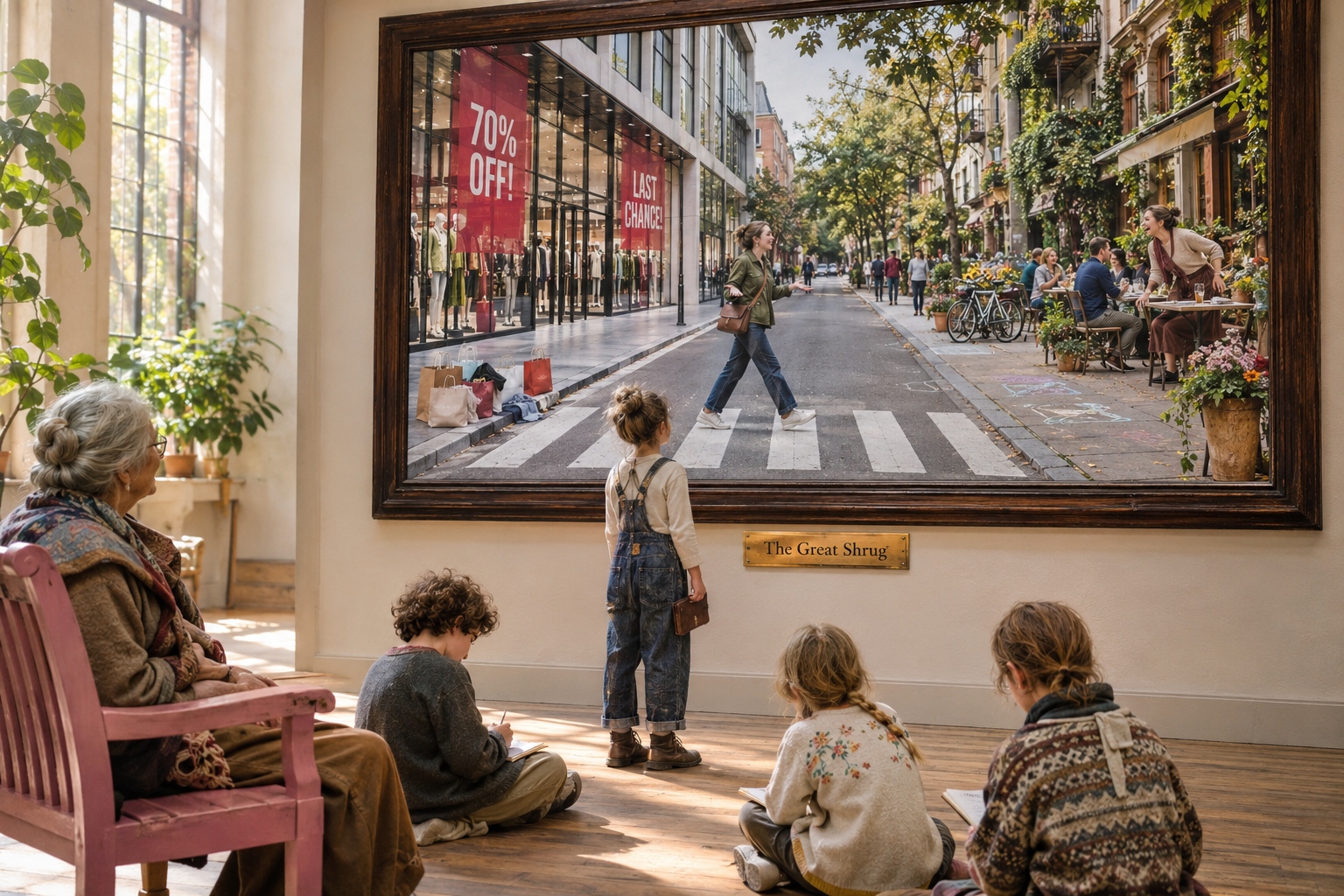
The most famous photo in the museum of the old world isn't of a war or a king. It's of a street crossing.
On the left side of the street stands a shop of the old kind: glass walls, rows of mannequins, and huge red banners shouting 70% OFF! and LAST CHANCE! On the pavement outside, someone has left a pile of shopping bags, still full.
On the right side is a café under the trees. Bikes, flower pots, chalk drawings on the pavement, people laughing over a long lunch. A woman in an apron is waving someone over.
And in the middle of the zebra crossing, mid-stride, a woman is walking from one side to the other. She's laughing. She doesn't look back.
Underneath, the caption just says: The Great Shrug.
Nobody knows who took the photo, who she was, or who left the bags. That's sort of the point.
What it was
It wasn't a revolution. Nobody stormed anything. There was no big speech, no leader, and no single day when it happened.
It was the slow moment when enough people (not all people, but enough people), in enough places (not in all places, but in enough places), looked at what the old world was offering them and simply went: meh.
You can fight a revolution. It's much harder to fight a shrug.
The photo gets one thing exactly right. The shrug wasn't only turning away from something. It was walking towards something else: people, trees, time, a long lunch with friends. Everything on the other side of that street is on the obvious list.
Two shrugs
People shrugged at two things at once.
The old rewards. Buy more. Earn more. Be seen more. New phone, bigger house, more followers. Meh.
The old sermons. Be kinder. Buy less. Try harder. Save the planet. Feel guilty. Meh to that too.
The second shrug mattered more. For centuries, people had been told to be saints inside a world built to make them fail, and then blamed when they did. Guilt, it turned out, didn't fix anything. It just made tired people more tired.
There was something very old in this. The Stoics taught people to separate what they can influence from what they can't, and to stop wasting worry on the rest. The Great Shrug was that idea becoming a whole culture: just what matters should matter.
What everyone suddenly understood
Underneath the shrug was one simple realisation: the problem was never the people. It was the design.
Once you saw it, you saw it everywhere. Most journalists weren't evil. The business model rewarded fear, so fear got made. Most salespeople weren't liars. The business model rewarded pushing, so pushing got made. You could swap in almost any old-world job, and the sentence still worked.
And then people flipped the sentence around:
Most people aren't saints. The design made the good thing easy, so the good thing got made.
The old world had small proofs of this all along. Finland's bottle deposit system never gave speeches about recycling. It just gave a little money back and put a return machine in every shop, and the vast majority of cans came back.
So people stopped asking each other to be better, and started building a world where being decent was the easy option.
Shrugging at everything that didn't matter
Once the shrug started, it spread to everything:
- Status. Job titles, luxury logos, whose car was newer.
- Work culture. "I'm so busy" stopped sounding important and started sounding sad.
- Attention. Likes, followers, notifications, being right online.
- Fear. Missing out, scary headlines, the latest thing to panic about.
- The life script. Job, mortgage, car, retire at 65. People started writing their own order, or skipping parts.
- Looks. Filters, diets, trends that were "in" one season and "out" the next.
How the noise faded
The hardest thing to shrug at was the noise: endless news, political fights, and outrage designed to keep people angry and scrolling.
It had already started in the old world. By 2025, about four in ten people said they avoided the news at least sometimes, mostly because it ruined their mood and wore them out. The Great Shrug turned that tiredness into a new habit:
- Rage stopped paying. Old feeds made money from attention, and nothing grabs attention like anger. When advertising collapsed, nobody earned anything from making people furious.
- The feeds were rebuilt. Feeds that end. A "sleep on it" button next to "send". Ranking that lifts what people who usually disagree both find useful.
- Small actions replaced helplessness. Outrage feeds on feeling powerless. When there was always something small you could actually do, doom-scrolling lost its pull.
- Fear lost its grip. With a floor nobody could fall through, scary messages landed on people who weren't scared.
- Politics lost its teams. Local decisions, lottery panels, no campaigns. Agitation needs sides, and there weren't any left.
And calm became popular. The non-drama corners of the internet became the busy ones. Moderators formed a respected army, the Calm Brigade, who could be called into any discussion that was overheating. The highest status online went to people who could explain the other side's view so well that the other side said "yes, exactly." (An old-world philosopher, Daniel Dennett, had recommended exactly that.) Changing your mind in public got applause. "I don't know" started to sound smart.
Rage-scrolling went the way of smoking indoors: completely normal, then slightly embarrassing, then something in old photos that makes people say "they did what?"
Why it spread
It was contagious. Once your friends stopped caring about brands, headlines or job titles, it got hard to keep caring yourself.
Nothing changes until what people consider normal changes. The Great Shrug was the moment normal changed. You can still see it in the data:
- The first year people repaired more things than they bought new. (The first repair café had opened in Amsterdam in 2009.)
- The year shared cars outnumbered private ones in a big city.
- Advertising falling year after year, and nobody missing it.
- Comment sections closing for lack of interest.
- People answering "what do you do?" with their hobbies instead of their jobs.
None of these happened everywhere at once. Each one spread from town to town, the way yawns spread across a room.
Nobody won
There were no villains in the end. The people running the old machine were mostly stuck in it too, working long hours to sell things to tired people who were working long hours to buy them.
And it took a very long time. The Great Shrug was centuries ago, and money only finally faded within Aino's lifetime. But looking back, that's when it turned.
A new shared story
Humans have always cooperated through shared stories: money, nations, companies. None of them are physical. They work because enough people agree they're real.
For thousands of years, we practised working together, for building and for war. The Great Shrug didn't invent a new kind of human. It pointed that practice at something better.
The old stories said: this money, this brand, this growth is real, so obey it. The new one says: all of it was made up, by us, so let's make up something better, together, and keep testing it.
It might be the most honest shared story humans ever had. It admits it's a story.
It never really ended
The Great Shrug is still here. It just became good manners.
The light ones have it. Every cheerful "who gives a shit?" about pink benches and changed song verses is a small shrug. So is choosing a studio over a penthouse because it's next to the bakery. So is letting a stranger be wrong online, and going for a swim instead.
Just what matters should matter.
Eevi's learning group visited the museum last week. Aino came too, and sat on the museum's bench, which someone, at some point, had painted pink. The other kids sat on the floor and drew the photo in their notebooks.
One of them asked whose shopping bags those were.
"Nobody ever went back for them," Aino said. "That's the whole story, really."
Eevi didn't draw. She stood right in front of the picture for a long time, holding her wallet full of leaves.
"I like her," she said, pointing at the woman on the crossing.
"Why?"
Eevi shrugged.