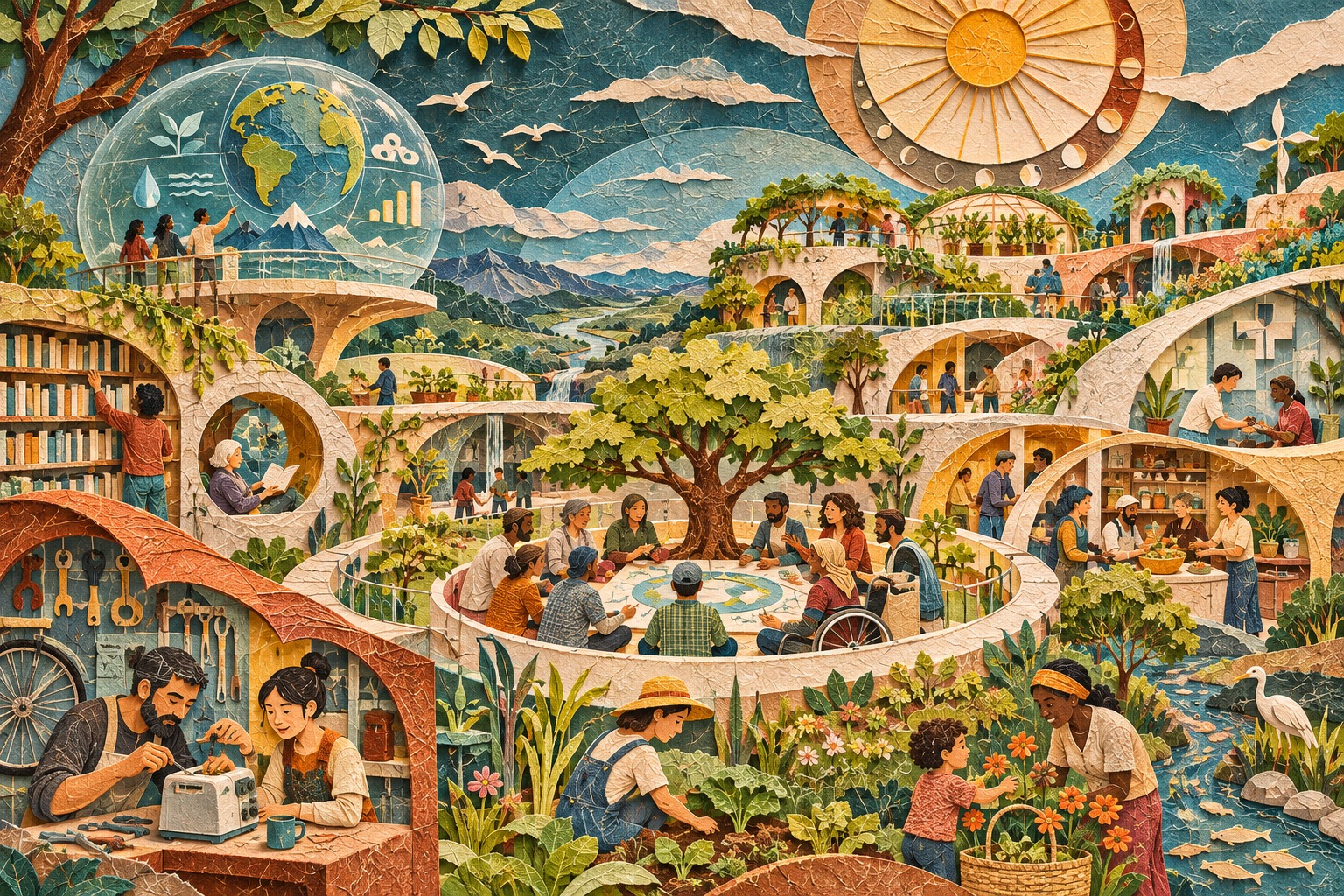
Same humans. Same planet. Same bad singing at birthdays. Only one thing has changed: the way people live together was finally designed on purpose.
If you arrived there from 2026, this is what you'd notice, roughly in this order.
In the first minute: the quiet. Hardly any cars. No adverts. Nobody running for anything.
In the first hour: nothing has a price. You look for somewhere to pay for your coffee, and there isn't one. The person who made it doesn't understand the question.
On the first day: nobody asks what you do. They ask what you're into.
In the first week: things are clearly getting done, but you can't find who's in charge. Nobody is. A shared page called the Earth-monitor shows what's broken and what's needed. People pick something when they feel like it. Not everyone does. Enough do.
In the first month: you get tired of resting and fix a wobbly bench. Nobody asked you to, which is exactly why you felt like it.
In the first year: you stop patting your pockets for keys and a wallet.
What you'd never notice
The rules, because there are only three: don't harm, don't deceive, and don't block others.
Everything else is optional. Helping, finishing what you start, even joining in at all. The whole thing is a hobby.
What hasn't changed
People. They're still grumpy, shy, lonely and wrong about things, the ordinary amount. Drains still block. Nobody gets more hours in a day, and nobody can be made to love anybody.
It isn't a perfect world. It's a floor nobody can fall through, with the ceiling left open.
What's left of 2026
Not much. Money and scarcity have mostly been phased out. Nobody banned them. They slowly stopped being needed, the way phone boxes did.
A few leftovers are kept around on purpose: a museum, an old wallet, a rental flat with the landlord's angry notes in a frame, and one man who still tries to sell courgettes. They're there so people remember how odd it used to be.
The one idea
None of this needed better people.
The old world kept asking people to be kinder, greener and harder-working, inside a setup that made all of that difficult. This one stopped asking. It made being decent the easy option.
The problem was never the people. It was the design.
This blog is a thought exercise about that design, told in small stories from one small town.
Don't take it too seriously.